
This post may contain affiliate links. See our affiliate disclaimer here.
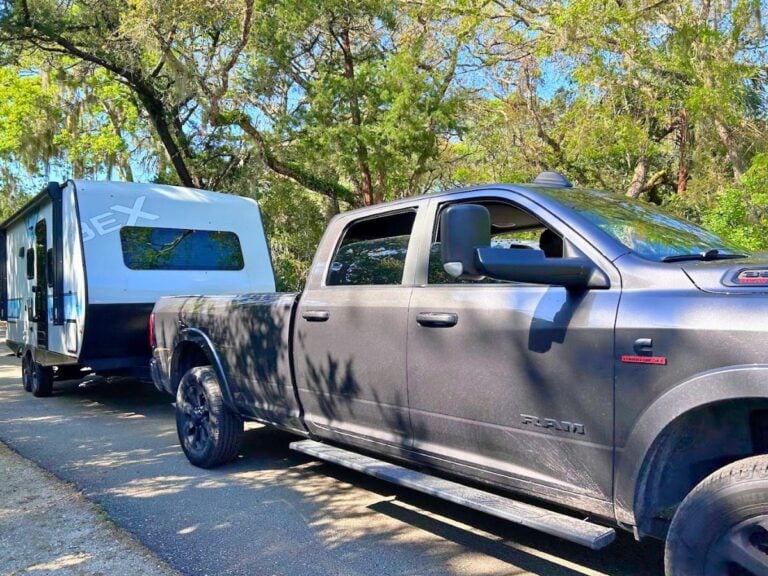
Towing with the incorrect tongue weight is a common mistake for travel trailer owners, and it can be a serious issue. Incorrect tongue weight can cause trailer sway and instability.
The good news is that checking your tongue weight is easy, and it only takes a few minutes with the right tool. In this article, I’ll explain what tongue weight is, what your trailer’s tongue weight should be, why it matters, and how to measure it using the BTBRV Tongue Weight Scale.
This post is sponsored by etrailer.com. They’re my go‑to for everything RV‑related, from campsite gear to hitches and replacement parts. I’ve been ordering from them for years and always get great customer service. I especially love their detailed product descriptions and video tutorials. They make it easy to get the right gear the first time.
What Is Tongue Weight?
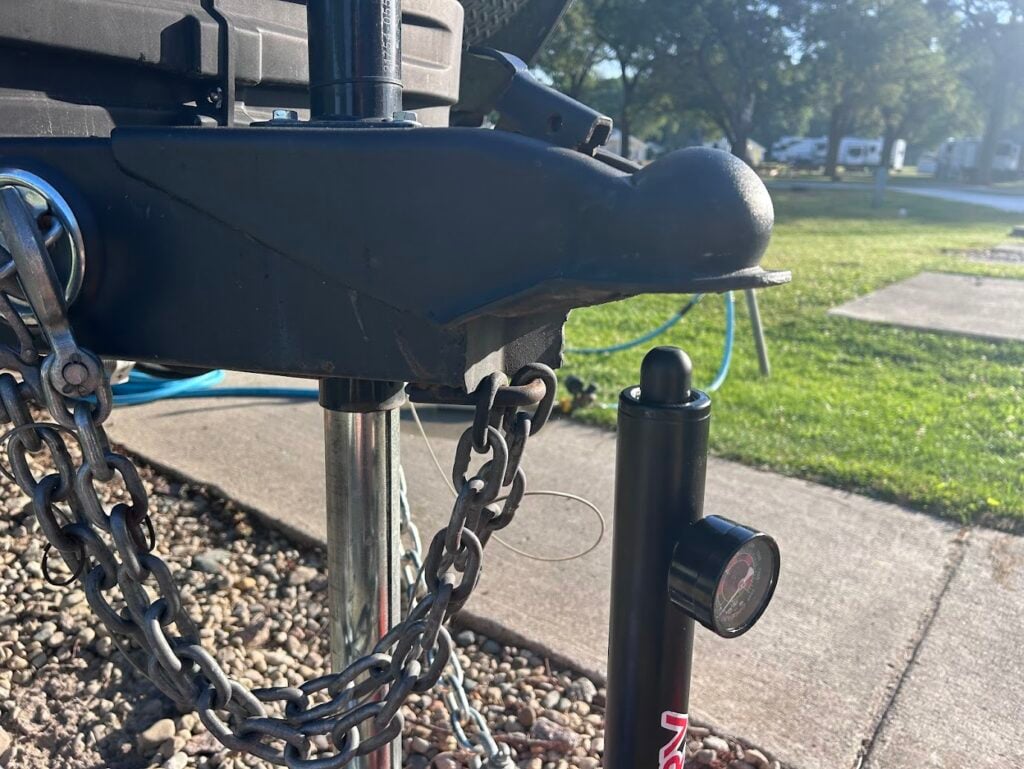
Tongue weight is the amount of downward force your trailer exerts on the hitch ball of your tow vehicle. Think of it as the portion of the travel trailer’s weight that’s being carried by the truck instead of the trailer’s axles.
For example, if your travel trailer weighs 7,000 pounds and the tongue weight is 750 pounds, that means 750 pounds of the trailer’s weight is resting on the hitch.
The location of your cargo, water tanks, batteries, propane tanks, and other gear all affect tongue weight. Even relatively small changes in how a trailer is loaded can have a noticeable impact.
What Should the Tongue Weight Be?
The ideal tongue weight for most travel trailers is 10% to 15% of the trailer’s loaded weight. Many RVers aim for the upper end of that range (12% to 15%) for improved towing stability, especially when towing a single-axle trailer.
Here are a few examples:
| Loaded Trailer Weight | Recommended Tongue Weight |
|---|---|
| 4,000 lbs | 400 to 600 lbs |
| 5,000 lbs | 500 to 750 lbs |
| 6,000 lbs | 600 to 900 lbs |
| 7,000 lbs | 700 to 1,050 lbs |
| 8,000 lbs | 800 to 1,200 lbs |
The key word here is loaded. Many RV owners know their trailer’s dry weight, but tongue weight should be based on how much the trailer actually weighs when you’re heading down the road.
That means including:
- Water
- Propane
- Batteries
- Food
- Clothing
- Camping gear
- Tools
- Anything else you carry
Signs Your Tongue Weight Might Be Wrong
While the best way to know tongue weight is to measure it, there are a few warning signs that your tongue weight may not be where it should be.
Possible Signs of Low Tongue Weight
- Trailer sway
- Trailer feels unstable at highway speeds
- Increased movement from wind or passing vehicles
Possible Signs of Excessive Tongue Weight
- Rear of truck squats significantly
- Steering feels less responsive
If you’re noticing any of these issues, checking your tongue weight is a good place to start.
How to Measure Tongue Weight
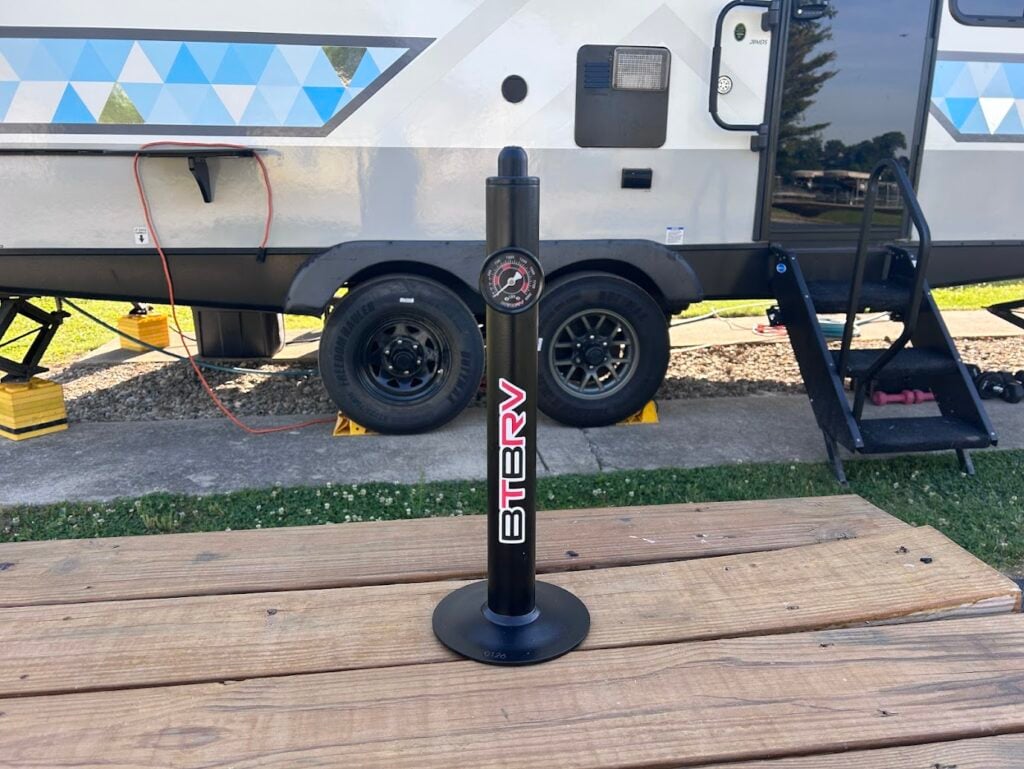
There are several ways to measure tongue weight, but many involve visiting a public scale, performing calculations, or taking multiple measurements.
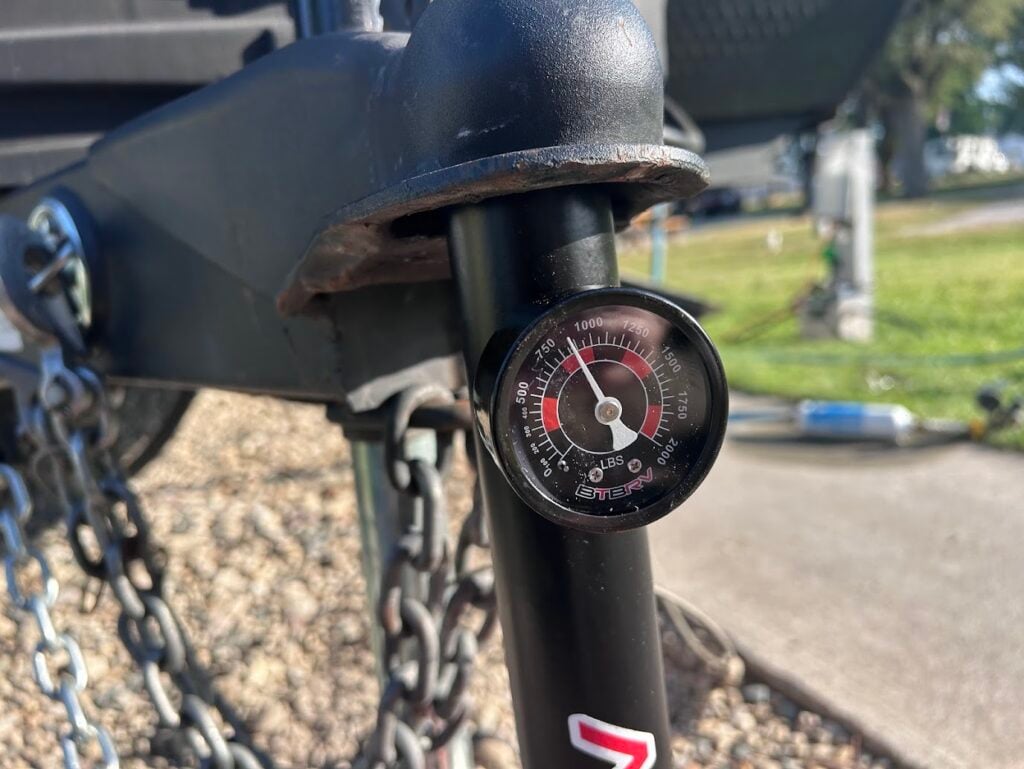
For RV owners who want a simple solution at home or at the campsite, a dedicated tongue weight scale is much easier. I recommend using the BTBRV Tongue Weight Scale from etrailer. The scale I used can measure tongue weight up to 2,000 pounds, but they also offer a lightweight version that measures up to 1,000 pounds.
How to Use the BTBRV Tongue Weight Scale
The process is straightforward, but it’s important to follow the manufacturer’s instructions.
Step 1: Park on Level Ground
Park the trailer on level ground. Pull the trailer forward approximately five feet after parking to help settle the suspension. Then, chock the trailer tires on both sides.
Step 2: Position the Scale
Place the BTBRV Tongue Weight Scale directly underneath the trailer coupler with the coupler unlatched. For the most accurate reading, the trailer tongue should be at its normal towing height during measurement. If needed, place blocks underneath the scale to achieve the correct height.
Step 3: Lower the Coupler Onto the Scale
Slowly lower the trailer coupler onto the scale. Once the coupler is fully supported by the tongue weight scale, continue raising the trailer jack until the jack foot is approximately one inch off the ground. At this point, the scale is supporting the trailer tongue weight.
Step 4: Read the Scale
Record the tongue weight shown on the scale. The BTBRV scale uses an easy-to-read dial that displays the measured tongue weight in pounds.
Step 5: Compare the Reading
Determine whether the reading falls within the recommended 10% to 15% range of your trailer’s loaded weight. To determine this, you’ll need to know how much your trailer actually weighs when it’s ready for travel.
The best way to determine your loaded trailer weight is to weigh it at a public scale, such as a CAT Scale. Load the trailer exactly as you would for a trip. Once weighed, use the total trailer weight to calculate your target tongue weight range.
If you don’t have access to a scale, you can make a reasonable estimate. Start with the trailer’s GVWR (Gross Vehicle Weight Rating), which is listed on the trailer’s data sticker. The GVWR is the maximum amount the trailer is allowed to weigh when fully loaded, so your loaded weight should not be above the GVWR.
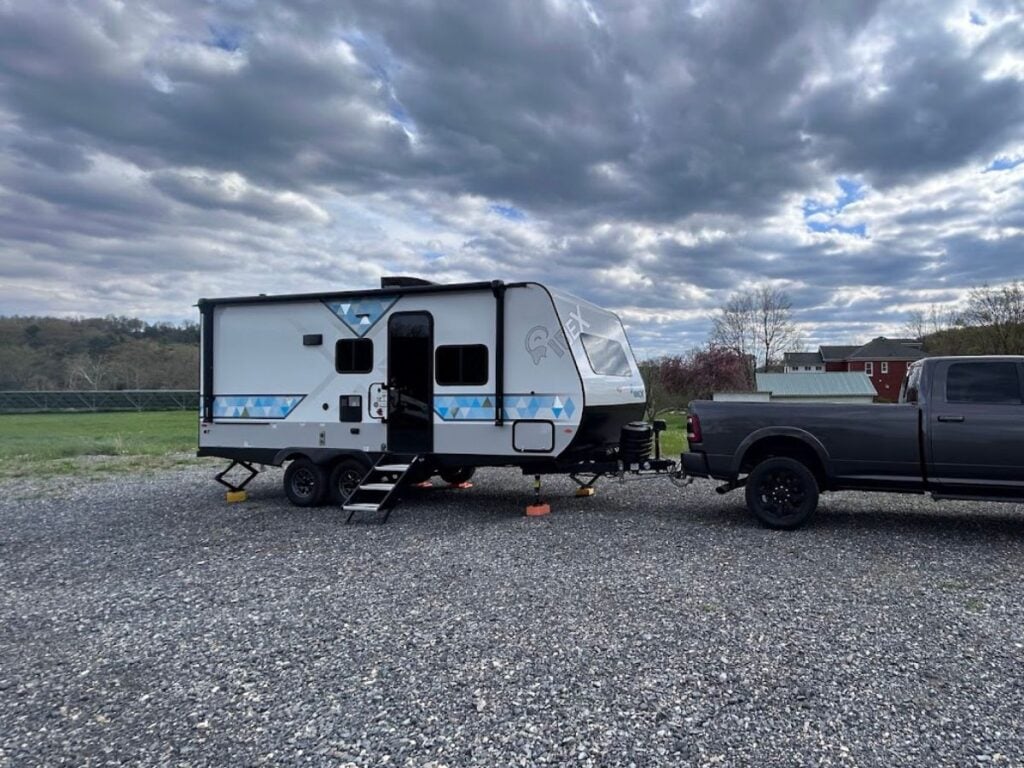
For example, my IBEX 20MDS has a GVWR of 7,683 pounds.
Since my trailer’s dry weight is significantly lower than its GVWR and I typically travel without full water tanks, I can reasonably estimate that my loaded weight is somewhere around 6,500 to 7,000 pounds.
Using 7,000 pounds as an estimate:
- 10% tongue weight = 700 pounds
- 15% tongue weight = 1,050 pounds
That gives me a target range to compare against my tongue weight measurement. However, many RV owners underestimate how much weight they’ve added to their trailer. If you’re serious about dialing in your towing setup, getting an actual weight at a scale is well worth the small cost.
Also remember that tongue weight counts against your tow vehicle’s payload capacity. Before towing, make sure your loaded tongue weight does not exceed the ratings for your tow vehicle, hitch receiver, ball mount, weight distribution hitch, or trailer.
How to Adjust Tongue Weight
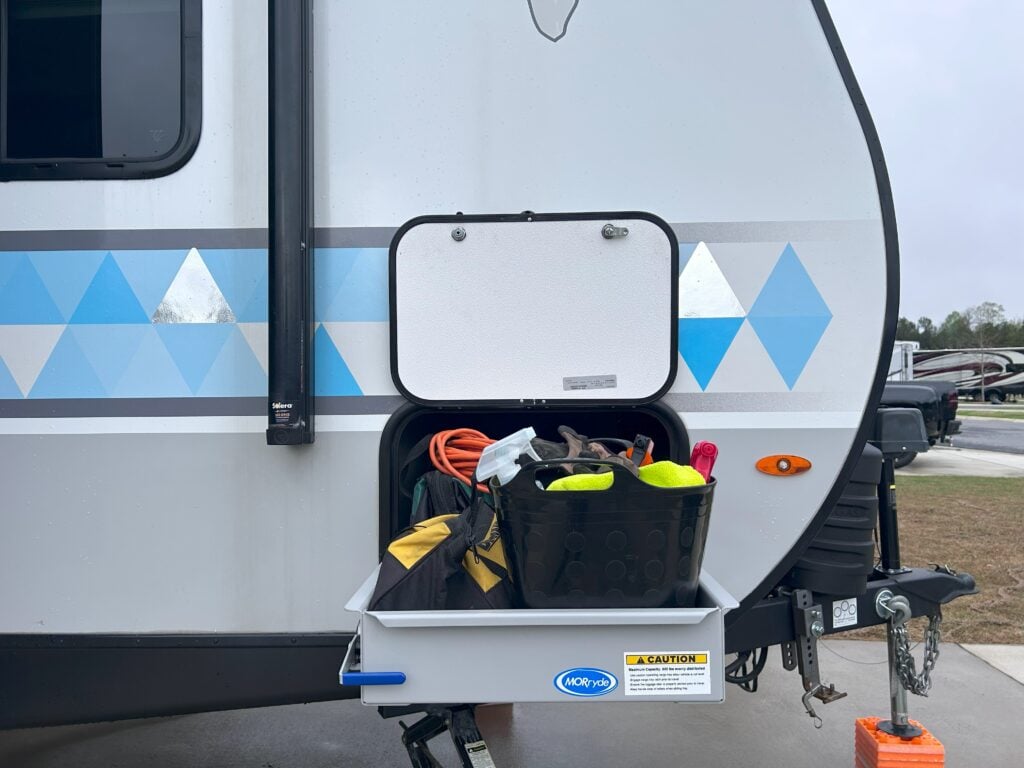
If your tongue weight is too low, move some cargo forward of the trailer axles.
If your tongue weight is too high, move some cargo rearward, while still keeping weight balanced and avoiding excessive rear loading.
A few things that commonly affect tongue weight include:
- Portable generators
- Toolboxes
- Cases of water
- Coolers
- Firewood
- Bikes
- Storage totes
Small adjustments can make a bigger difference than most people expect.
Proper tongue weight plays a major role in towing safety and trailer stability. If you’ve never measured yours, there’s a good chance the result might surprise you.
The BTBRV Tongue Weight Scale makes it easy to verify your setup and make adjustments before you hit the road, helping create a safer and more comfortable towing experience.
Once you’ve adjusted your tongue weight, check out these 10 additional ways to make RV travel days easier.
Happy Camping!

Christina Pate is a seasoned full-time RVer who, along with her husband Justin, has journeyed across the US, Canada, and Mexico. Drawing from her extensive travels, RV repairs and RV renovations, she founded Travels with Ted to guide and inspire fellow RV enthusiasts. Christina is also the co-author of The Owner’s Guide to RV Maintenance and the creator of My RV Log Book.
